
22 Dec 2025
Most EMI banks and payment institutions are still underwriting and servicing merchants using delayed, abstracted, and incomplete financial data. By the time accounting reports are prepared and reviewed, the reality of the business has already changed. Risk has shifted, cash flow has moved, and opportunities—both for growth and intervention—have already been missed.
The problem is not payments. The problem is visibility.
And that visibility starts at the POS layer.
This article is written for EMI banks and licensed payment institutions operating across multiple jurisdictions that are seeking:
Better merchant visibility and risk understanding
Lower merchant churn and higher lifetime value
Smarter lending and embedded finance models
Stronger, more defensible merchant relationships
For decades, point-of-sale (POS) systems were treated as simple checkout tools. In reality, POS software has become one of the most critical layers of financial infrastructure in modern commerce.
Every retail and hospitality business runs its economic life through its POS system:
Sales and refunds
Pricing, discounts, and taxes
Cash flow and settlement timing
Staff activity and productivity
Inventory movement and stock velocity
Yet most payment providers still rely on backward-looking accounting data rather than real-time operational data generated at the POS.
Across global retail and hospitality markets, many merchants still operate on legacy POS systems that:
Run on a single terminal
Lack real-time cloud synchronisation
Offer no web dashboard for owners or finance teams
Provide no mobile apps for business monitoring
Expose no structured API access to business data
These systems were never designed to support modern financial services such as dynamic credit assessment, revenue-based lending, or real-time risk monitoring.
HowToPay POS was built as an API-first, real-time business data platform, not just a payment interface.
Through structured APIs, EMI banks can access permissioned, live operational data including:
Real-time gross and net sales
Transaction-level item detail
Payment method breakdowns
Daily cash flow patterns
Refunds, voids, and anomalies
Staff and shift performance indicators
This enables:
Faster and more accurate underwriting
Continuous merchant health monitoring
Early detection of risk or distress
More competitive and fair pricing of financial products
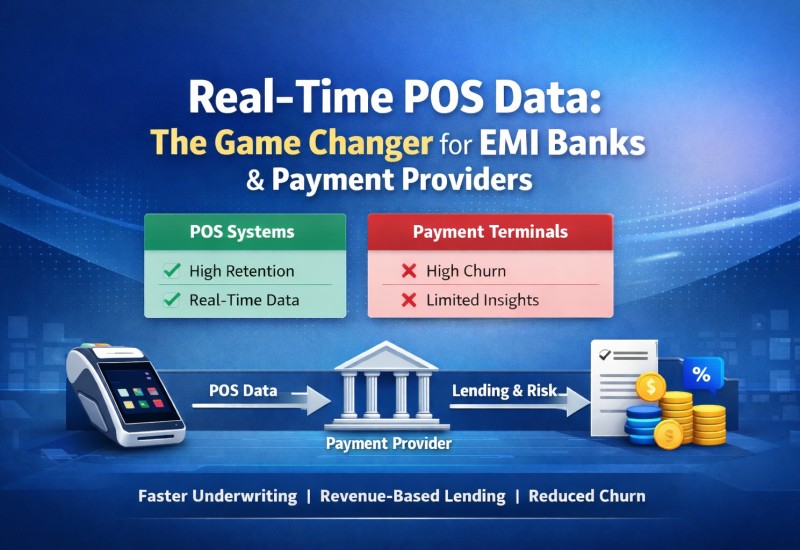
Payment terminals are commodities. Merchants regularly switch providers based on small pricing changes or promotional offers.
POS systems are fundamentally different.
The POS is the operational core of a business. It controls:
Menus, products, and pricing logic
Staff access, shifts, and permissions
Inventory and supplier workflows
Business reporting history
Once embedded, switching POS systems introduces operational risk, retraining costs, and potential downtime. As a result, POS platforms are inherently sticky, delivering significantly lower churn than standalone payment terminals.
For EMI banks, integrating at the POS layer rather than the terminal layer results in:
Longer merchant lifecycles
Higher lifetime value (LTV)
Reduced price-based churn
Stronger competitive defensibility
HowToPay POS enables a clear and continuous data flow:
Transactions occur at the POS in real time
Operational and financial data is normalised and structured
Payment providers receive live visibility via APIs
Lending, risk, and settlement decisions adapt dynamically
This replaces static, historical reporting with living financial insight.
Access to real-time POS data allows EMI banks to offer:
Revenue-based lending aligned to actual performance
Faster credit approvals for growing merchants
Adaptive limits that scale with the business
These capabilities materially improve merchant acquisition while significantly reducing churn. Merchants are far less likely to leave a provider that understands their business and grows alongside them.
HowToPay POS is designed for EMI banks operating across multiple countries and regulatory environments:
Cloud-native architecture
Cross-platform Flutter applications (Windows, Android, macOS, Web)
Consistent data models across devices and regions
API-driven integration for financial institutions
This allows payment providers to deploy a unified strategy across markets while maintaining local compliance.
HowToPay POS is not positioned as a vendor product. It is designed as long-term financial infrastructure for EMI banks and payment institutions.
By embedding at the POS layer, providers move beyond transaction pricing and become integral to the merchant’s daily operations, decision-making, and growth.
For EMI banks seeking deeper merchant relationships, better risk insight, and lower churn, POS integration is no longer optional.
HowToPay POS offers a strategic entry point into real-time merchant intelligence and long-term infrastructure partnerships.
HowToPay POS is not where payments end. It is where financial intelligence begins.
EMI banks and licensed payment institutions interested in strategic POS integration, data partnerships, or embedded finance collaboration are invited to make direct contact.
Mr Cameron McKean
Chief Executive Officer
Confidia Limited
Email: [email protected]